














Ten mistakes in the report below. I made most of them.
New tech and new protocols get the attention. There are a thousand posts a week on them. The hard work happening on the ground is less clickable. The sweat, the tears, the wins nobody sees. Foundations, reputation, team.
Part of why it stays quiet is that the conversation is hard. It takes humility, self-awareness, and a willingness to say what you got wrong with your name attached.
So I asked. Twenty-six doctors answered, in the open. I compiled it into a field report below. It is a work in progress, and that is the point. If we want a standard for longevity medicine, we have to put this out and let others build on it.
As always, Happy Sunday.
Dr. David Luu, Founder, longevity docs.™
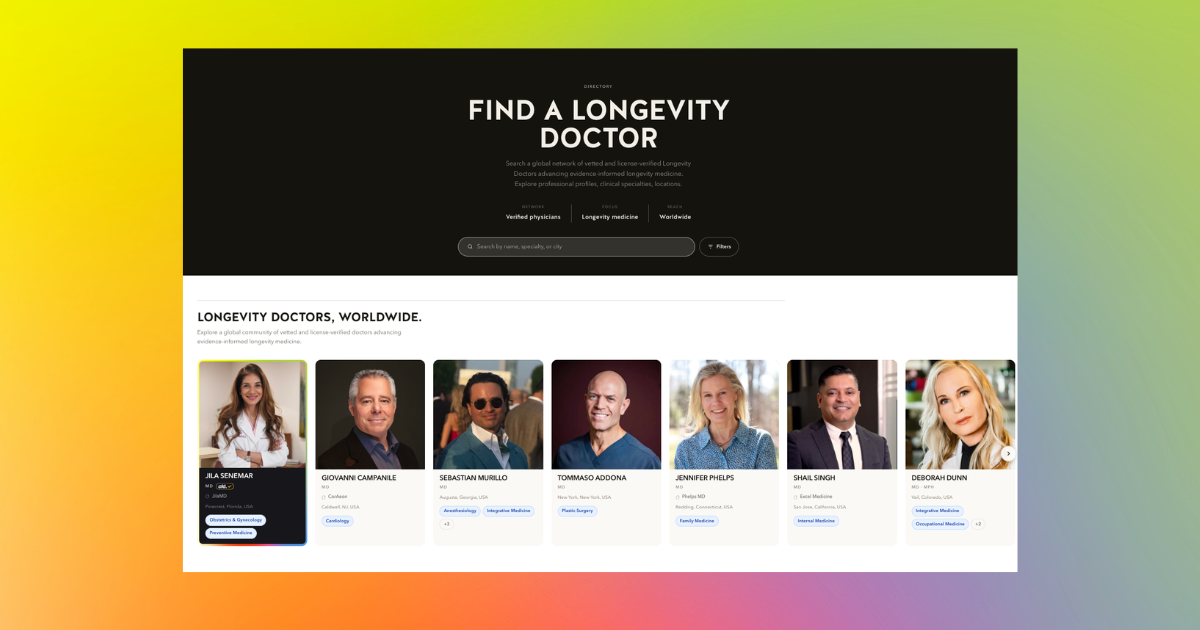
PS. Built the technology. Built a complex product. Built a multi-offering. Built a place. Maybe I should not have. I learned from all of them. We were building something that did not exist yet. Happy to give back now. These are the photos from that time.
One story a week for physicians moving into longevity medicine (part 2).
A field report from 26 physicians.
What 26 physicians would do differently
Longevity medicine has a growing clinical literature and no operational one. Physicians opening practices have no published standards, no pricing benchmarks, no model comparisons, no software evaluations, and no account of what the first eighteen months actually cost.
So we collected one. Over the course of a week we put a series of questions to physicians in the member chat on longevitydocs.ai and let them answer each other in the open. Twenty-six responded on the record, from two months in practice to twenty-three years.
Ten mistakes came back often enough to treat as the operating reality of the field rather than one person’s bad luck. Insurance does not pay for this work. Most physicians underprice at launch. The payment model decides how you practice, not just how you get paid. Capital gets spent before demand exists. Service lines get added before any of them are good. Paid marketing loses to the physician’s own voice. Income tied to time caps the practice. Access given without terms is the most common boundary failure. No software does the job, so everyone runs workarounds. And systems get built only after something breaks.
One condition sits under all ten. Longevity medicine is an emerging field. Cardiology has had since 1949, when the American College of Cardiology was founded, to build its benchmarks and its guidelines. We are starting to build it for longevity medicine.
We know the medicine. We are still learning the business.
Published work in longevity medicine covers what to measure and what to prescribe. It says nothing about the conditions the medicine gets delivered in.
So every physician entering the field solves the same problems from scratch. What to charge. Whether to take insurance. Membership or fee for service. Which software. When to hire. Each one solves it alone, pays for the errors alone, and never finds out what anyone else learned.
Nobody has asked the people who know.
Community-sourced field report
Questions were posted in the member chat on longevitydocs.ai over the course of a week. Physicians answered in an open thread, visible to each other, and were told their answers would be quoted by name, with the option to stay unnamed.
Questions covered early mistakes, what they would build differently from zero, technology, and operations.
Twenty-six physicians contributed. Experience ranged from two months to twenty-three years. Settings included solo boutique, concierge, membership, hybrid fee for service, and pre-launch. Quotes are verbatim, trimmed only for length.
Ten mistakes, in the order they cost you money
Ten mistakes recurred across respondents.
- Expecting insurance to pay for longevity testing
- Underpricing at launch
- Letting your payment model decide your medicine
- Spending on space and equipment too early
- Building every service line at once
- Spending on paid marketing instead of your own voice
- Tying your income to your time
- Giving away your access without boundaries
- Waiting for the perfect EMR
- Waiting to build systems until you need them
1. Expecting insurance to pay for longevity testing
Steven Murphy named it as his first error in exactly those words. Every respondent who addressed insurance had made the same one.
Murphy rebuilt his around three moves: explain why the patient should pay for it, identify where insurance legitimately covers something based on a medical diagnosis, and make clear you will be a good steward of their spend. “That built a trusting Sherpa relationship where I could then navigate the ship for best labs at best prices.”
His constraint: “Don’t expect to be able to spend this much time with a patient and have insurance pay for your time.”
Jijoe Joseph found the more dangerous version, which is partial coverage.
“I got insurance wrong by assuming that ‘usually covered’ was good enough. About 1 in 8 patients could still get a surprise $4,000 to $5,000 bill.”
He negotiated pricing at roughly 80% off retail, then built his own panel and folded the cost into his plans so pricing was predictable upfront. Partial coverage is worse than none. It moves unpredictable risk onto the patient, and the surprise lands on your relationship.
Melissa Loseke has been cash pay since 2012 and is the only respondent looking the other way. She sees parts of this work drifting toward coverage and says the open question is “determining when to start utilizing insurance again.” She already uses insurance for prescriptions where she can.
Key Insights
- Be transparent on coverage from the first visit
- Partial coverage is the trap, not cash pay
- Price so nothing surprises the patient
- Watch reimbursement, some of this work is drifting toward coverage
- Your call depends on size, ethos, scale, treatment mix, patient base
2. Underpricing at launch
Near-universal. The regret is not the number. It is that the number is hard to change later.
Melissa Loseke: “I should have started pricing higher. Most of my colleagues would chastise me for how little I charge. And that’s harder to walk back now.”
Shah Ahmed, one year in, correcting it now: “I know I will lose people but I undervalued myself for a year.”
Jijoe Joseph, past it: “You’ll be surprised how many stay after the price increase.”
Steven Murphy offers the bridge for anyone who cannot wait on revenue. Price the practice where you intend to sustain it and fund the ramp elsewhere. He points to Medicare work in short term rehabs and SNFs, “where there is zero overhead.”
Key Insights
- Set the price you intend to sustain, from patient one
- Raising it later is harder than starting there
- Fewer patients leave than you fear
- Need cash early? Take low-overhead work outside the practice
- Do not discount the core offer to fill the calendar
3. Letting your payment model decide your medicine
The most consequential finding came from a physician who changed her model to fix her medicine.
KeriLyn Bollmann spent twenty-three years with the underserved and underinsured before moving into longevity practice. On fee for service she says
“I was nervous to ask people to come back (and pay money), so instead I would see them, do some testing, give them some supplements, and then they would feel lost for next steps.” She moved to concierge to ensure “consistent follow up, so people felt like we were moving the needle.”
Fee for service made her reluctant to ask patients to return. That reluctance removed follow-up. Without follow-up, testing produces confusion instead of care. She changed the payment structure to restore the clinical loop.
Julie Doyle reports the same from the other side. Unlimited portal messaging, same-day replies.
“I would not have been able to offer this outside a membership structure... I’m never feeling like answering messages or responding to patient questions is uncompensated time.”
Jijoe Joseph gives the timeline. He ran both.
“Membership was slow for almost two years. Fee for service kept the lights on.” New patients are now membership only.
His planning note: “Whatever overhead you estimate, double it.”
Key Insights:
- Not a payment decision, it decides how you practice
- Membership funds follow-up and continuity
- Fee for service optimizes the encounter
- Pick the one that fits the medicine you want to deliver
- Check it covers overhead and pays you properly
4. Spending on space and equipment too early
Shah Ahmed lists renting space and buying equipment “thinking I would do so many things” among his first-year errors.
Steven Murphy on sequencing: “Make money first, assess patient needs and then buy one thing at a time.” He also names the pressure that produces bad capital decisions. A patient told him she loved him but got more at another practice. “That stung, but good business is not reacting to every sting with bad economic decisions.”
Shoma Datta-Thomas bought devices she did not need and says she should have hired admin help earlier. The equipment was the wrong purchase. The person was the right one.
Ahmed’s counterfactual is the cleanest alternative on record:
“If I could go back I would literally just open a PLLC, rent a desk somewhere, and do some light organic marketing and social content.”
Key Insights:
- Start lean, buy one thing at a time, after demand is proven
- Hire the person before the device
- Shiny object syndrome is expensive
- Patients pay for trust, outcomes, access: ask whether the purchase delivers any of those
5. Building every service line at once
Jijoe Joseph named this as his number one:
“Every vertical adds equipment, staff, training, marketing, and management complexities before demand is proven.”
Mark Dukshtein gives the number:
“Trying to add too many services at once instead of being really good at 2-3.”
Shoma Datta-Thomas found demand somewhere she had not planned for. She expected more GYN minor procedures. “Patients were begging for good hormone therapy.” Her rule is to iterate the menu on observed demand, fast.
Daniel Kessler applies the same logic to case selection:
“Start with something solvable that gets the patient results quickly. Do not start with the complex cases.”
Jonathan Stegall puts the boundary around who rather than what:
“Don’t try to be everything to everybody. Define your ideal patient avatar and go after them.”
Key Insights:
- Narrow the offering to what you are good at
- Listen to your patients, measure traction before adding
- Every added service adds equipment, staff, training, marketing
- Start with solvable cases
6. Spending on paid marketing instead of your own voice
Melissa Loseke would cut all of it:
“Word of mouth and just doing a great job with patients is all you need.”
Shah Ahmed ran the comparison inside his own practice without intending to. He spent $20,000 on local ads. His social account reached 17,000 followers “despite zero formal strategy and completely erratic posts.” His conclusion:
“Now imagine if I took the 20k in local ads and put that into a real social team instead.”
Twenty thousand dollars of advertising underperformed inconsistent posting by the physician himself.
Jonathan Stegall states the principle:
“You don’t need perfect videos or perfect social media posts. The public wants your authenticity, not your perfection.”
Key Insights:
- Your voice outperforms paid ads and costs nothing
- Patients choose a physician, not a clinic
- Raw beats polished content
- Word of mouth is still the strongest channel
- Spend on the work before the ads
7. Tying your income to your time
Jonathan Stegall: “Don’t tie your income to your time. Put systems in place early so that other people in your practice are doing the heavy lifting.”
Jijoe Joseph states the target:
“a business that can keep working even when the founder takes a step back.”
Shah Ahmed is inside the problem and says so. Compensation directly tied to time with patients. He is announcing memberships and building workflows an APP or nurse can run.
What he wishes he had: “a ‘business’ partner... someone to look over my shoulder and help me avoid silly mistakes.”
Ladi Ilkhani reduces it to three instructions: “Ask for help and take it. Delegate instead of trying to do it all myself. Billing consistently.”
Katie Rybak on the spending decision underneath:
“I wouldn’t be so afraid to spend the money on quality staff. They are everything to a successful practice.”
Haleem Mohammed:
“I wouldn’t do it alone. Easy way to burn out. I’d find a group of like minded killers with no ego who live and breathe medicine.”
Key Insights:
- If you only earn when you are in the room, you are the ceiling
- Ask for help and take it
- Delegate before you are drowning, not after
- Hire good staff early, train them, keep them
8. Giving away your access without boundaries
Shah Ahmed identifies the asset: “People are paying to sit down and talk to me. The value is the physician.” Which makes the rest harder to explain. Ladi Ilkhani:
“I also would protect my ‘time,’ something I never thought we could put more value on. Shouldn’t have given out my cell so easily.”
Melissa Loseke changed her number over it.
“I changed numbers because of this. Most had little respect for my time or awareness.”
Sarah Lacarrubba would define roles, ownership, and accountability from day one:
“Set clearer boundaries and trust more slowly. In the beginning, I blurred the lines between being a boss, mentor, friend, and business partner, and I was too generous with trust, titles, and credit.”
Key Insights:
- You are the asset, protect the time and the access
- Set expectations at visit one, not after they slip
- Give out a practice line, not your cell
- Define roles, ownership, and accountability before anyone is a partner
9. Waiting for the perfect EMR
Lisa Menuet, opening a practice soon, asked the simplest question in the thread: does anyone have an EMR they love?
The answers describe a category that has not been built.
Haleem Mohammed says his most used app is not his EMR.
“Doximity Ask is probably the most used app in my entire phone... helps me organize my thoughts, create notes, my social post captions are fact checked on there and I use the dialer to do telehealth video visits.”
Tatiana Zeballos gave the most complete account. Solo boutique practice on SimplePractice, valued for one thing: app-based messaging that feels like texting, with “no emails directing patients to a portal, repeated logins, password resets, or other EPIC-like friction.” As she adds services she needs lab integrations, e-prescribing, wearables and high-risk merchant processing without losing that.
“Essentially, I’m looking for the unicorn: SimplePractice ease plus a more robust longevity-medicine EMR.”
She has tried Charm, Practice Better, OptiMantra and Elation. She is evaluating Ultralight Health and SigmaMD, with Ultralight the current front-runner.
Bismarck Cadet on Ultralight: “awesome and continues to improve.” Mohan Muvvala runs Hint Health core and clinical, and rates the marketplace integrations and the responsiveness of the team.
Steven Murphy names the system hardest to change later. “It’s really hard to switch EMRs.” Choose for patient communication and documentation from day one. Retention runs through it.
Salomé Masghati answered the question the way the market should find most interesting. Does she have an EMR she loves? “Yes, the one we created ourselves.”
Maloes Zadeh diagnoses why none of it resolves. What is missing is “a truly integrated longevity platform that brings together labs, imaging, wearables, lifestyle data and longitudinal trends and translates them into clinically meaningful, evidence based actions.” Measurement is solved.
“The real challenge is turning all that data into better clinical decisions rather than simply generating more dashboards.”
Key Insights:
- No full integrated EMR is built for this field yet, do not delay technology implementation
Originally published in The Longevity Medicine Intelligence newsletter (#103).