






In 2020, I put everything I could on a dashboard: biomarkers, imaging, sleep, activity, recovery. Measuring gave me understanding. It guided interventions and helped me build better habits. Whether it changes outcomes or mortality, I can't say yet. But it made me fall in love with longevity medicine, and with the complexity of human systems biology.
Now patients arrive with dashboards of their own, often explained first by the companies that sell the tests. Our role is not to take the data away. It is to ask what it means, what it changes, and whether acting on it helps.
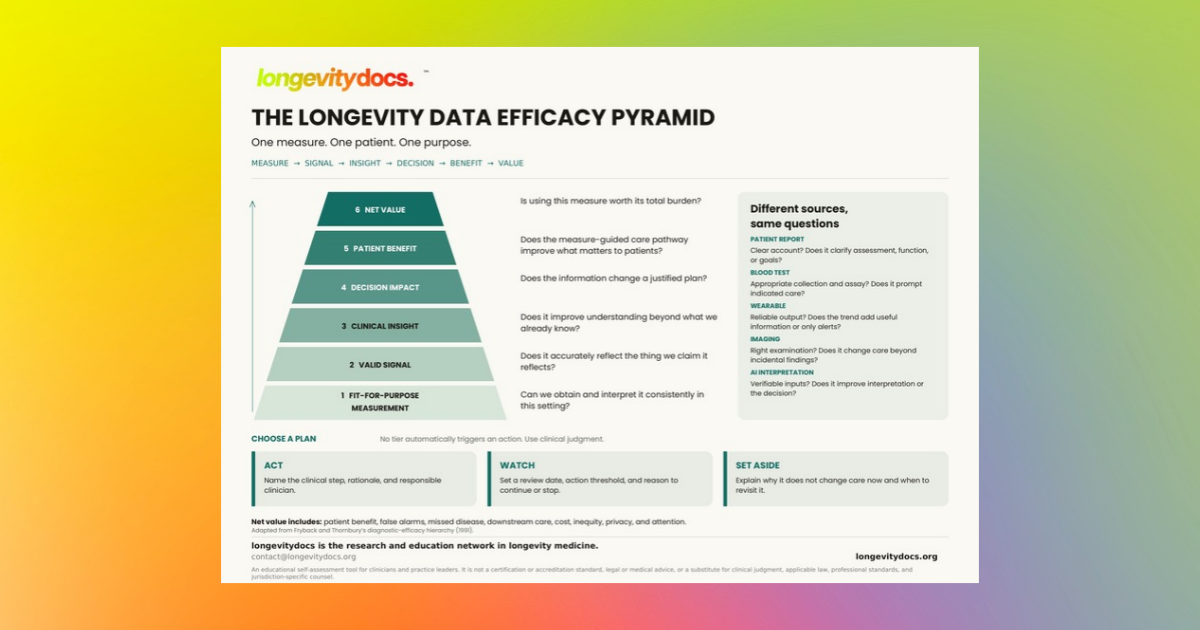
That is why I created the Longevity Data Efficacy Pyramid: six questions to help physicians and patients decide what to act on, what to watch, and what to set aside.
As always, Happy Sunday.
Dr. David Luu, Founder, longevity docs.™
The Longevity Data Efficacy Pyramid
For years, we said we didn’t have enough data for precision medicine. Now we have more than we can interpret.
A patient arrives with a biological-age score, a glucose trace, a full-body MRI report, sleep data, and an AI summary connecting it all. She has invested time, money, and attention. Now she wants to know which number to fix first.
Apps and AI are already interpreting these numbers for her. What a dashboard can’t offer is clinical context, accountability, and a plan. That’s our part.
Give all data a job
Before you order, read, or repeat a result, finish this sentence with the patient:
“We are measuring this so we can decide whether to…”
The decision might be to diagnose a condition, estimate risk, monitor treatment, support a habit, or stop testing.
Accuracy and value are separate questions. Fryback and Thornbury separated a test's technical performance from its effect on decisions and outcomes. The CDC's ACCE model does the same for genetic tests.
The pyramid
We adapted that logic for longevity care: one measure, one patient, one purpose. For each measure, ask how far the evidence supports using it for this particular purpose. The pyramid evaluates a use, and it works the same way for a lipid panel and an epigenetic clock.
Measure → Signal → Insight → Decision → Benefit → Value
- Fit-for-purpose measurement. Can we obtain and interpret it consistently here? How was it collected, is it complete and repeatable, and what could distort it? Patient-reported fatigue counts as data. Elicit it carefully and record its context.
- Valid signal. Does it reflect what we claim it reflects? A reliable measurement can still be a poor indicator of the condition, risk, or physiological state we want to understand. A wearable graph shows that something changed. It takes clinical reasoning to explain why.
- Clinical insight. Does it add to what we already know? A recovery score may capture variation, but does it tell you more than asking about sleep, illness, training, alcohol, or travel?
- Decision impact. Does it change a justified plan? Decide in advance what follows a positive, negative, or changing result, and who will review it. A clinical indication needs more than "interesting to know."
- Patient benefit. Does care guided by this measure improve what matters to the patient? The goal is a patient who feels better, functions better, or lives longer. A biological-age score or HRV reading is a way to get there.
- Net value. Is using this measure worth its total burden? Consider false alarms, false reassurance, incidental findings, downstream tests, money, privacy, and attention. Then consider what another dashboard might displace: sleep, movement, work, or time with people.
Each question builds on the one before it, and each needs its own answer. A measure can be accurate and still fail to change care.
Then agree on a plan
Reaching a tier does not trigger an intervention. Finish with one of three decisions:
- Act. Name the clinical step, the rationale, and the responsible clinician.
- Watch. Set a review date, an action threshold, and a reason to continue or stop monitoring.
- Set aside. Explain why the result doesn’t change care now and what would justify revisiting it.
The Longevity Data Efficacy Pyramid accompanies this issue. Try it this week in clinic: one measure, one patient, one purpose, and a decision at the end.
Originally published in The Longevity Medicine Intelligence newsletter (#108).