









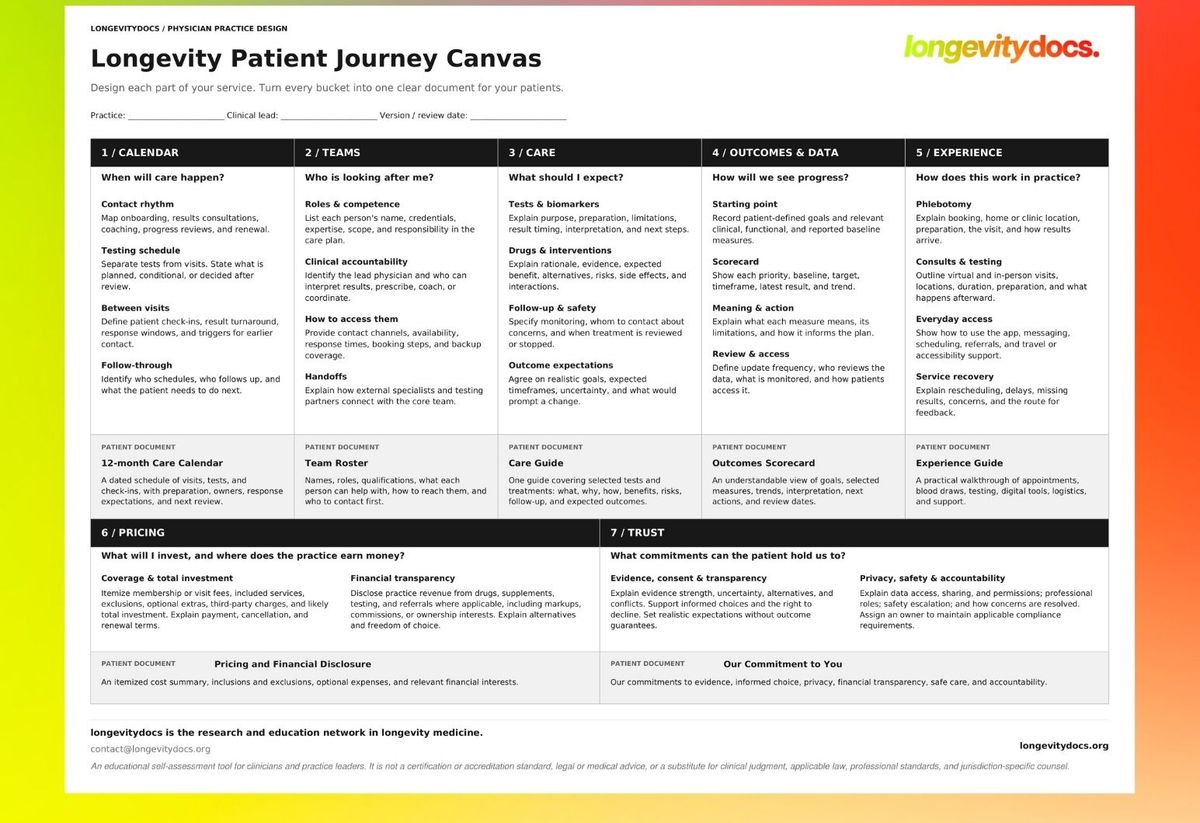
In this issue 105, the last of the series: the Longevity Patient Journey Canvas.
My prediction: more physicians will leave the corporate clinic and the health system over the next few years to own their practice. Most of them want to do medicine, not run a business. They will need to be equipped anyway, because a patient who walks into a longevity clinic is trusting a physician with the rest of their life. That is the job. Not the newest biomarker, peptide, or ring, however much we enjoy those. Patient outcomes first, and a standard of care we set ourselves before someone else sets it for us. The Canvas is a start.
The rest of the issue is a lesson in reading headlines. Semaglutide gave old mice 12% more life. Pelacarsen lowered Lp(a) and did not lower events. A biomarker moving is not a patient doing better. Longevity medicine is a complex system, and the only way to practise it is with humility, with standards, and in the service of the patient.
As always, Happy Sunday.
Dr. David Luu, Founder, longevity docs.™
The 7-Part Canvas to Standardize Longevity Care
Three weeks ago this series started with why doctors are making the move. Then 26 physicians said what not to do. Last week, the systems. This week, the patient’s year, on one page.
The physician who leaves the health system to open a longevity practice becomes two people at once: the doctor and the operator. Ownership is the reward. It is also the problem, because there is no department to hand the year to. Every touchpoint, every price, every promise to the patient is now a decision the physician makes, or fails to make, alone.
Hospitals solved this with standards. Longevity medicine has not written its own yet, so most practices run on the founder’s memory. That holds at 40 patients and breaks at 200.
The Canvas is the standard on one page. Seven questions every patient is already asking, and for each one, a document the patient leaves with. Fill it in with what the practice actually does. The empty boxes are the work.
The 7 parts
1. Calendar When will care happen? The rhythm of the year: baseline, results, coaching, retesting, the annual reset, and what happens in between. The patient leaves with: a 12-month Care Calendar.
2. Team Who is looking after me? Who owns the plan, who interprets results, who prescribes, who coaches, and who to contact first. The patient leaves with: a Team Roster, with names.
3. Care What should I expect? The rationale, evidence, and limits of every test and intervention, with expectations that do not promise what biology cannot deliver. The patient leaves with: a Care Guide.
4. Outcomes How will we see progress? The few measures that matter, baseline to trend, including the one the patient chose. The patient leaves with: an Outcomes Scorecard.
5. Experience How does this work in practice? How blood draws, imaging, the app, and messaging fit a life with travel and a job, and what the practice does when something goes wrong. The patient leaves with: an Experience Guide.
6. Pricing What will I invest, and where does the practice earn money? The fee, the inclusions, the likely extras, and where the practice earns revenue, including on supplements, testing, and referrals. The patient leaves with: a Pricing and Financial Disclosure.
7. Trust What commitments can I hold the practice to? How the practice handles evidence, uncertainty, consent, privacy, safety escalation, and conflicts of interest, in writing. The patient leaves with: Our Commitment to You.
Download it, fill it in, share it with your team.
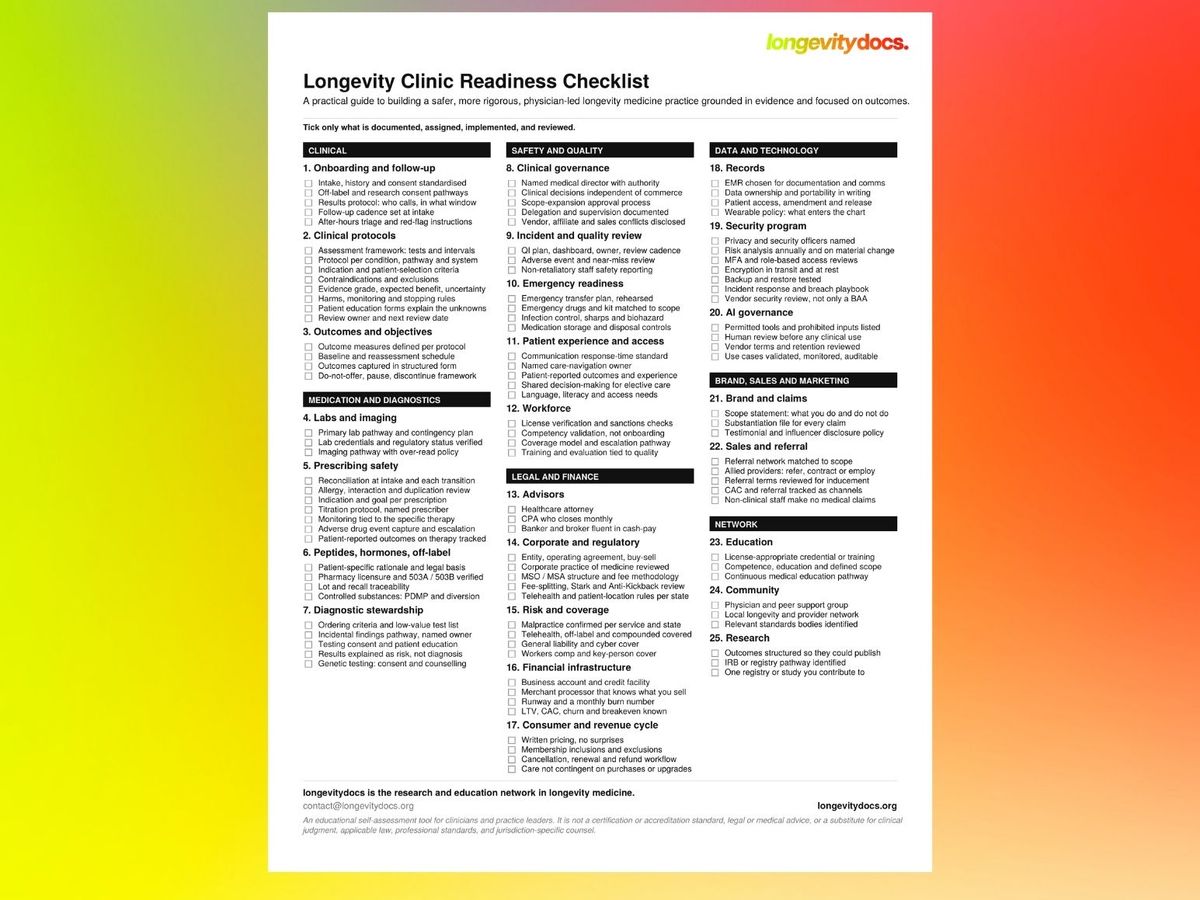
Missed last week? The Longevity Clinic Readiness Checklist is on the website.
Originally published in The Longevity Medicine Intelligence newsletter (#105).