



I find it fascinating that although innovation is everywhere (from AI to multi-omics to wearable sensors) healthcare still runs on legacy systems. We’re surrounded by breakthroughs, yet most clinics still depend on EMRs built for billing, fax machines for communication, and phone calls for scheduling.
This is the innovation dilemma: when industries become so optimized around outdated models that they can’t evolve. Medicine is caught in what economists call technological lock-in: systems so complex, regulated, and interconnected that true reinvention feels impossible.
Longevity medicine gives us a chance to start fresh; to design an infrastructure that learns, adapts, and connects science with care in real time. And that’s what makes this moment so exciting.
Healthy Sunday!
PS: Just finished a beautiful brunch with my family flying in from the Caribbean and friends stopping through from LA. Making time for the people who matter most feels incredible… a reminder to truly enjoy life while we can.
Dr. David Luu Founder, longevitydocs www.longevitydocs.org
In this week newsletter:
- Cover Story: The Longevity EMR of the Future
- Buzz in the Chat: EMRs crisis • Peptides Pharmacy
- Research Radar: Aging as a Loss of Goal-Directedness • Clinical skills in the age of AI assistance
- Longevity in the News: Status symbol • Naked Mole Rats
- Longevity Intelligence: Hers & Menopause • Noninvasive Cancer Therapy
We all feel it. The system just doesn’t work. So I decided to write about what should.
I feel you, doctors. I’ve been there too. We’ve all tried them, and yet no platform truly fits how we practice longevity medicine. We spend hours managing data instead of patients. And deep down, we all agree: EMRs weren’t designed for us.
They were built for insurance billing, not precision health management. They optimize for codes, not outcomes. And that’s why every longevity doctor I talk to ends up saying the same thing: “I’ve tested everything, nothing works.”
So I thought I’d write about my dream tech stack, what a true Longevity EMR of the future could look like if money, legacy systems, and bureaucracy weren’t in the way.
You can’t design what you don’t know
Most EMRs were built for transactional care by brilliant engineers who never operated a clinic or talked to a patient. But our world is different. We focus on incredible patient experience, cash-pay care, and data-rich, continuously evolving protocols.
We integrate multi-omics, therapy protocols, continuous monitoring, and lifestyle data. We coach patients on everything from prediabetes management to VO₂ max optimization. No billing system can capture all of that.
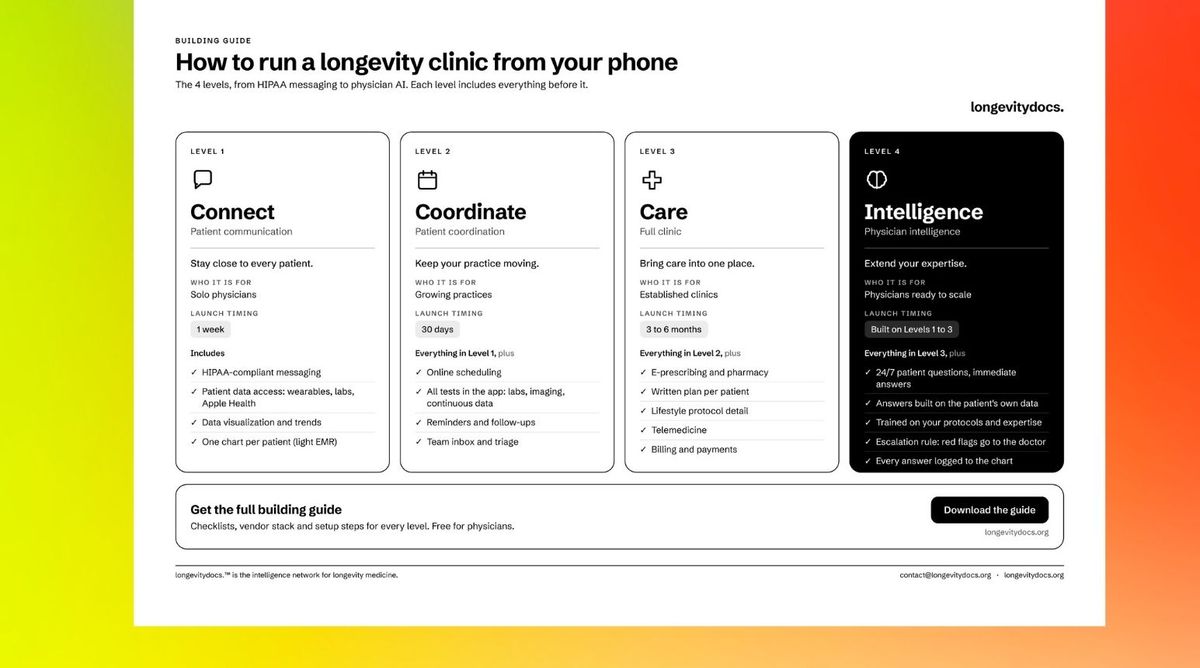
What longevity doctors need isn’t a new EMR. We need a longevity operating system that thinks and learns with us.
The future Longevity Operative System
If we could start from scratch, it would be open source, intelligent by default, and built for both doctors and patients, not one or the other.
Most B2B EMRs solve for physician workflow. The future must be B2B2C, bridging both sides of care.
It should learn automatically, adapt in real time, and understand context. No more dropdowns and endless forms. Instead, imagine a prompt-first interface where we ask: “Hey LOS, which patients are out of range today?” “What therapies should we adjust right now?”
This isn’t science fiction. It’s design thinking, a clinical AI copilot that helps us interpret, act, and personalize faster.
And beyond data, it should act. A marketplace that books therapies, ships peptides, and recommends interventions with transparent evidence scores based on collective clinical outcomes.
My dream longevity tech stack
For patients: Education and empowerment through evidence-based content, ambient AI coaching, and one unified dashboard that connects wearables, labs, and behavior, private with data ownership yet seamlessly shared with their doctor.
For doctors: The system integrates multi-omics biomarkers, imaging, protocols, and notes. AI scribes document visits, while protocol builders let us design and share evidence-based treatment stacks. Payment and analytics are built in, not bolted on.
For research: Every patient could voluntarily contribute anonymized data to a global longevity registry and be incentivized for it. An AI engine would learn from thousands of clinics, turning daily care into real-world research in partnership with health systems.
For community: A network where longevity physicians exchange insights, troubleshoot tough cases, and publish findings together. Our collective practice becomes our collective evidence base.
For trust & compliance: SOC2-grade security, transparent AI logic, and true data ownership by doctors and patients. No hidden algorithms, no public data leaks. More patient data sovereignty and transparency.
Longevity doctors don’t need another EMR. They need an intelligent clinical ecosystem that mirrors how we actually practice longevity medicine, preventive, data-driven, and deeply human.
Originally published in The Longevity Medicine Intelligence newsletter (Issue 67).