












The AI doctor was born this year, not in a hospitaI.
I was at CES to speak about longevity medicine and technology, and what I saw was clear: AI, robots, and digital health are no longer being built for medicine. They are being built as medicine: designed to improve health, extend life, and redefine how care is delivered.
I’m deeply grateful to represent longevitydocs and to speak on the stage of one of the world’s most influential technology conferences, seeing longevity medicine recognized as a legitimate field and a movement of the future.
The convergence of longevity medicine and technology is no longer theoretical. It’s here. And it’s an extraordinary moment to be part of this revolution alongside the physicians and innovators shaping what comes next.
Dr. David Luu - Founder, longevity docs.™
Each week, I try to explore one idea that could advance longevity medicine and hopefully support physicians in bringing it to life.
What It Means for longevitydocs, and Why Physicians Must Lead This Transition
The AI doctor didn’t arrive with a white coat or a press conference. It arrived quietly, and soon it will be everywhere.
ChatGPT for Healthcare is analyzing patient data and citing medical literature. Function is integrating lab results into consumer AI tools. Doctronic is prescribing medications autonomously in Utah. AI is now serving patients directly through analysis, education, and now prescription.
But AI isn’t just for patients. It’s already embedded in how physicians work: notes, workflows, clinical decision support, and increasingly, patient care itself. Doctors are using it whether they’ve formally adopted it or not.
For longevity medicine, AI is not optional: it’s mandatory. Longevity care is longitudinal, preventive, and inherently data-heavy. It requires detecting weak signals early, tracking trajectories over time, and integrating biology with behavior, environment, and lifestyle.
We’re working with multi-omics, advanced imaging, continuous lifestyle data, and interventions that span every organ system and aging pathway. No single physician -no matter how experienced- can manually process, synthesize, and monitor all of this in real time.
AI becomes the infrastructure that makes modern longevity medicine possible, while the physician remains the one who interprets, decides, and guides.
The 5 Biggest Opportunities for Longevity Medicine
1. Earlier Signal Detection Across Aging Pathways
Subtle shifts in inflammation, metabolic flexibility, sleep architecture, hormonal balance, or mitochondrial function are almost impossible to track manually across time and systems. AI excels at longitudinal pattern recognition across organs and pathways, exactly where early intervention matters most in longevity medicine.
2. N-of-1 Precision at Scale
AI makes it possible to practice true personalized longevity medicine at scale. By continuously analyzing labs, wearables, imaging, multi-omics, and lifestyle data over years (not single visits) AI allows physicians to track individual biological trajectories and deliver N-of-1 care without sacrificing precision as practices grow.
3. More Time for Clinical Judgment and Human Care
By automating intake, synthesis, and documentation, AI frees physicians to focus on what cannot be automated: interpretation, strategy, motivation, context, and trust. The longevity doctor shifts from data processor to clinical architect.
4. Expanded Access to Longevity Expertise
Hybrid AI + physician models allow longevity doctors to serve more patients without compromising standards, critical as demand for preventive and longevity care continues to outpace supply.
5. Stronger Clinical Consistency
Used correctly, AI can reinforce evidence-based care, reduce unnecessary variability, and support best practices - while still allowing physicians to personalize decisions based on biology, goals, and risk tolerance.
The 5 Risks longevitydocs Must Take Seriously
1. Patient Confusion and Data Overload More data is not always better. AI-generated summaries can overwhelm patients, amplify benign abnormalities, and drive anxiety without proper physician framing.
2. Overtesting and Overintervention Large panels can increase false positives. Without restraint, AI-driven insights can push patients toward unnecessary supplements, testing cascades, or interventions.
3. Deskilling of Physicians Over-reliance on AI risks weakening first-principles clinical reasoning. Longevity doctors must remain deeply fluent in biology, not passive reviewers of algorithmic output.
4. Governance, Privacy, and Liability Gaps HIPAA, BAAs, data ownership, consent, and liability remain unresolved in many AI deployments. If AI makes a mistake, responsibility is still human and unclear.
5. Premature Autonomy AI is not ready to independently diagnose or treat complex, multi-system longevity patients. Moving too fast risks harm, regulatory backlash, and erosion of trust.
What longevitydocs Should Do Now
The opportunity is real. The risks are serious. But waiting is not a strategy. Longevity physicians must act now, not by rushing to adopt every new tool, but by leading with intelligence, discipline, and a clear plan.
1. Educate and Train Your Team
AI literacy is now clinical literacy. Physicians and staff need to understand what AI can do, what it cannot do, and where human judgment remains non-negotiable. This means training on:
- How AI tools work and where they fail
- Interpreting AI-generated outputs critically, not passively
- Explaining AI recommendations to patients clearly and accurately
- Recognizing when AI is creating noise instead of signal
Education isn’t a one-time event. It’s an ongoing commitment as tools evolve and new capabilities emerge.
2. Assess Accuracy and Clinical Validity
Not all AI tools are created equal. Before integrating any AI system into your practice, you must assess:
- Clinical accuracy: Does it perform well in real-world longevity populations?
- Evidence base: Is it built on robust data or marketing claims?
- Transparency: Can you understand how it arrives at recommendations?
- Failure modes: What happens when it’s wrong, and how will you catch it?
Longevity patients are complex and don’t fit clean diagnostic categories. Any AI tool used in this space must be validated for the populations you serve, not just tested in general medicine cohorts.
3. Build Your Own Model or Partner with the Right Tech Companies
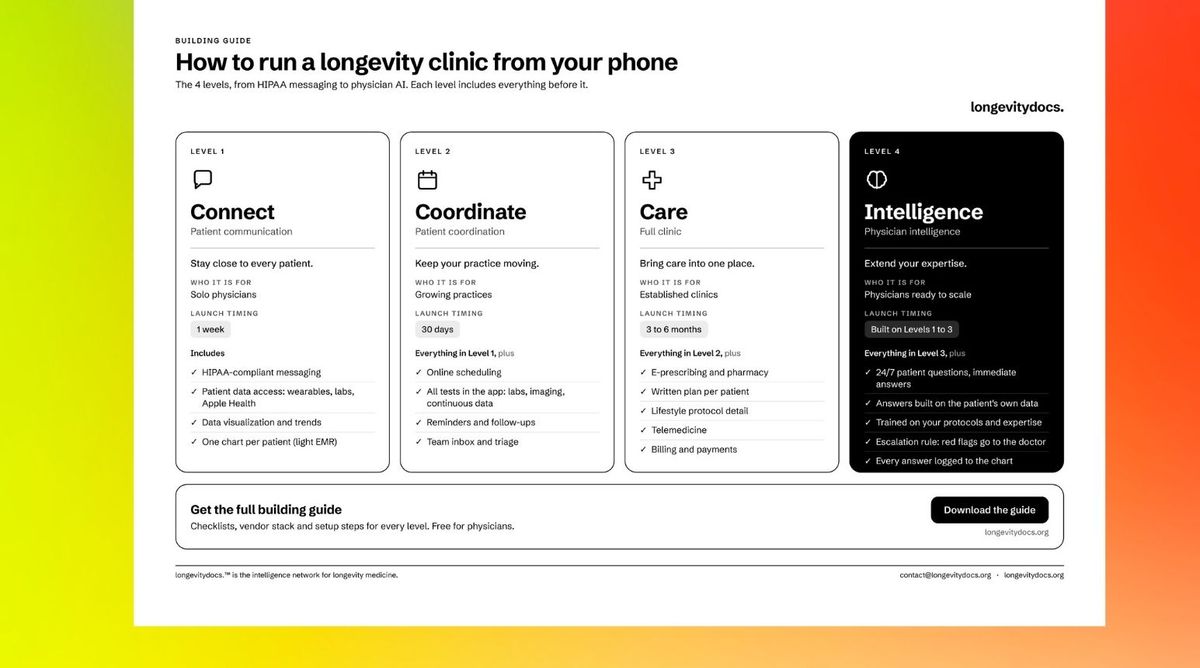
Longevity doctors have two paths forward: build proprietary AI systems tailored to your practice, or partner with technology companies that align with your clinical values.
If you build, you control the data, the algorithms, and the integration, but you also own the risk, cost, and operational complexity.
If you partner, choose carefully. Look for companies that:
- Prioritize clinical outcomes over efficiency metrics
- Offer transparent governance and HIPAA-compliant infrastructure (including BAAs)
- Allow physician oversight and the ability to override recommendations
- Are willing to co-develop solutions with clinicians, not just sell to them
The worst outcome is passive adoption: letting platforms, payers, or influencers decide how AI gets deployed in longevity care. If physicians don’t lead this transition, others will.
AI is not coming to longevity medicine. It’s already here.
ChatGPT is analyzing patient data. Function is integrating labs into AI tools. Doctronic is prescribing medications. The era of AI-augmented care has begun.
For longevity doctors, this is not a threat. It’s a responsibility. The doctors who engage with AI thoughtfully -who educate themselves, assess tools rigorously, and build or partner strategically- will define how longevity medicine scales. Those who wait will lose influence over how care is delivered.
The future of longevity medicine won’t be built by algorithms alone but by doctors who know how to use them. If you want to be in the room shaping AI-powered longevity care, join our AI & Tech Mastermind in NYC · January 31.
Every week, the longevitydocs WhatsApp group feels like a front-row seat to the future of medicine. Here’s what had doctors buzzing:
Originally published in The Longevity Medicine Intelligence newsletter (#77).