











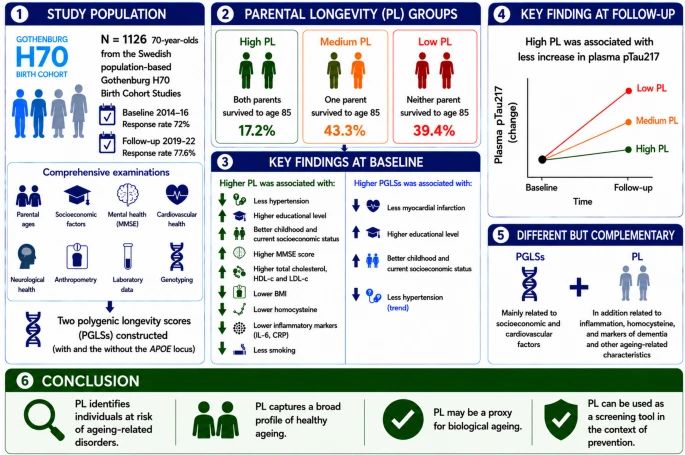
The study
1,126 Swedish 70-year-olds, followed six years. Having two parents who lived past 85 tracked with less hypertension, higher MMSE, lower BMI, lower homocysteine, lower IL-6 and CRP, less smoking, and a slower rise in plasma pTau217. A GWAS-derived polygenic longevity score only tracked with socioeconomic factors and fewer heart attacks. The two measures did not correlate. Inflammation and pTau217 findings did not survive multiple-comparison correction. White cohort, self-reported parental ages.
What it means for practice
the cheapest longevity biomarker in your intake is two questions about the patient’s parents. Add parental age at death to your history if it is not there.
Source: Seidu et al., GeroScience, Sep 11, 2026
Originally published in The Longevity Medicine Intelligence newsletter (#106).