









The study
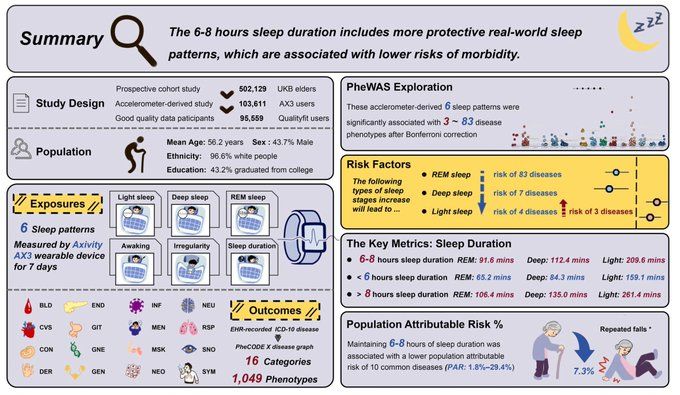
Nearly 96,000 UK adults wore a wrist tracker for a week, and researchers followed their health records for about nine years, checking against more than a thousand diagnoses. People who got more REM sleep were less likely to develop 83 conditions, including heart failure (26 percent lower risk), atrial fibrillation (17 percent lower) and dementia (46 percent lower). More deep sleep went with less type 2 diabetes and depression. Broken and irregular sleep went with more anxiety, depression and substance dependence. Total sleep followed a U-curve: 6 to 8 hours was the low-risk zone for most conditions, and sleeping under 5 hours accounted for 37 of the 41 links to higher risk.
What it means for practice
We already knew sleep cuts morbidity. We now know how to measure it at scale, and this study shows the pieces that matter: more REM, more deep sleep, less time awake after falling asleep. The open question is how do you get more REM and deep sleep, and less WASO? The honest answer is that we have very little trial evidence for moving any of the three on purpose, and a tracker cannot measure them well enough to know if you did. What holds up is simpler. Duration and regularity are the levers we can pull, and both moved the rest in this cohort.
Source: Luo et al., PLOS Medicine, Sept 17, 2026
Originally published in The Longevity Medicine Intelligence newsletter (#107).