







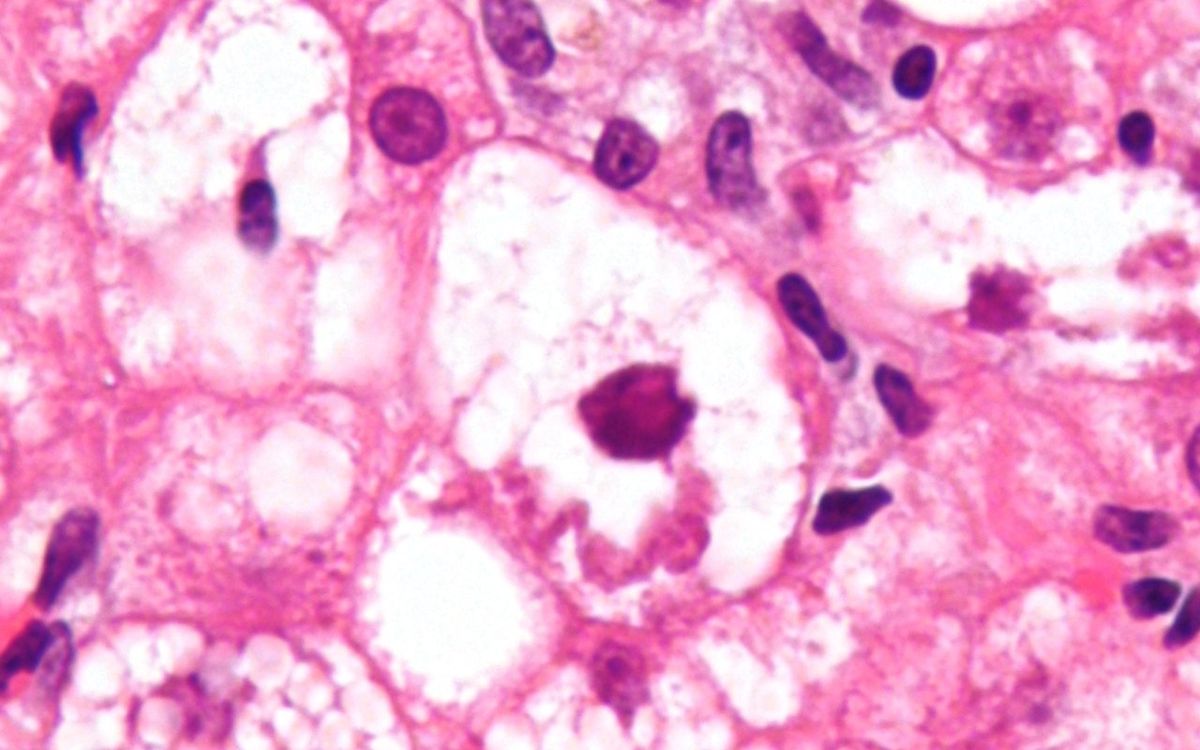
The first placebo-controlled trial of a senolytic in MASH hit its primary endpoint. Thirty-one adults with biopsy-proven fibrotic MASH got dasatinib 100 mg plus quercetin 1,000 mg, three days a week for three weeks, repeated in three cycles over 21 weeks, or placebo. Paired biopsies were read at the end.
- Fibrosis improved by at least one stage without MASH worsening in 47% on D+Q versus 7% on placebo (P = 0.02).
- MASH resolved in 53% versus 7% (P = 0.02).
- NAFLD Activity Score fell by 1.43 points versus 0.39 (P = 0.012).
- Adverse events were more common on D+Q (82% versus 43%), all self-limiting.
The authors are clear about the limits. Seventeen patients were treated, 27 finished, the confidence interval is wide and follow-up was 21 weeks. This is a proof-of-principle trial, not a treatment.
Why it matters
This is the strongest human senolytic signal of the year, and it lands in the liver, where biopsy gives a hard endpoint instead of a biomarker. The intermittent hit-and-run dosing is the real story: clearing senescent cells for a few days a month and letting tissue repair. Do not prescribe D+Q for MASH on 31 patients. Do watch for the phase 3, and expect patients to ask about it this week.
Source: Koning, Meijnikman et al. Senolytics dasatinib and quercetin in metabolic dysfunction-associated steatohepatitis: a proof-of-principle randomized, controlled trial. Nature Metabolism, October 1, 2026.
Originally published in The Longevity Medicine Intelligence newsletter.